What Are Wild Maine Blueberries —
And Why Do They Make Better Scones?
Most people have only ever tasted a cultivated blueberry. Once you try wild Maine blueberries baked into a scone, you'll understand immediately why Maine bakers have been reaching for them for generations.

Wild Maine blueberries: smaller, more intense, and better in every baked good.
If you've ever wondered why our Wild Maine Blueberry Lemon premium scone mix tastes noticeably different from other blueberry baked goods, the answer starts with the berry itself — long before cream, flour, or a hot oven enter the picture.
Wild Maine blueberries aren't just blueberries from Maine. They're a different species, grown in conditions that produce a flavor that cultivated blueberries simply can't replicate. Here's what sets them apart — and why that difference matters enormously once you put them in a scone.
What Are Wild Maine Blueberries?
Wild Maine blueberries (Vaccinium angustifolium) are a lowbush variety native to the rocky barrens and hillsides of Maine and eastern Canada. Unlike the large highbush blueberries you'll find in most grocery stores, wild blueberries grow low to the ground on plants that have thrived in the same acidic Maine soil for centuries — not cultivated in rows, but managed in their natural habitat.
Maine is the largest producer of wild blueberries in the United States, and the state's famously cold winters, short growing season, and naturally acidic soil create exactly the stress conditions that concentrate flavor in each small berry. The result is a fruit that's significantly smaller than cultivated varieties — roughly the size of a pea — but packed with more flavor, more antioxidants, and a tartness that cultivated blueberries simply don't have.
Harvest runs from late July through September. The berries are traditionally raked by hand across the rolling, strikingly beautiful barrens of Downeast Maine before being quick-frozen to lock in their peak-season flavor year-round.
Wild Maine vs. Cultivated — Side by Side
The differences go well beyond size. Here's how they stack up across the qualities that matter most for baking:
4 Reasons Wild Maine Blueberries Make Better Scones
The differences above aren't just interesting facts — they translate directly into why your scone comes out better. Here's what happens in the oven:
They don't water down the dough
Wild blueberries have lower water content than cultivated. In a scone, that means no soggy patches, no uneven texture, and no wet streaks through the crumb. The dough bakes exactly as it should from edge to center.
More berries in every bite
Because wild blueberries are so much smaller, you get significantly more of them distributed throughout the dough. Instead of one large berry every few bites, you get consistent blueberry flavor in every single piece.
The flavor deepens under heat
Wild blueberries' sweet-tart complexity actually intensifies when baked. That natural tartness is exactly what the lemon in our mix is designed to work with — together, they create a flavor that keeps getting better the longer you think about it.
They hold their shape
Large cultivated blueberries burst and bleed through scone dough, leaving purple streaks and inconsistent texture. Wild blueberries stay compact and well-defined, giving you a clean, consistent crumb from the first bite to the last.

Every bite has blueberries — that's the wild berry difference.
Why Maine?
Maine produces more wild blueberries than anywhere else in the United States, and the reasons are rooted in the state's geology and climate. The acidic, well-drained soil of Maine's coastal barrens — the same geology that makes the coastline so dramatic — is precisely what wild blueberry plants have evolved to thrive in. Cold winters force the plants into dormancy. A short, intense summer concentrates their energy into producing fruit rather than foliage.
The result is a berry that has nowhere to send its sugars and flavor compounds except into itself. That's why wild Maine blueberries taste more like blueberries than any other blueberry you've had — they're the real thing, grown under pressure, in the place they've always grown.
The barrens of Downeast Maine — low, rolling fields that glow deep red each autumn as the leaves turn — are one of the most visually striking agricultural landscapes in the country. If you've ever driven through Washington County in September and seen those fields, you already know exactly what we're talking about.
Wild Blueberry Heritage Center
Looking for a wild Maine blueberry adventure? Visit the heritage center and see the giant blueberry dome! wildblueberryheritagecenter.org
Machias Wild Blueberry Festival
Held every year in the heart of blueberry country, the Machias Wild Blueberry Festival is a celebration worth the trip. machiasblueberry.com
Frequently Asked Questions
What's the difference between wild and regular blueberries?
Are wild Maine blueberries healthier than regular blueberries?
Why do wild blueberries taste better in baked goods?
Where can I buy wild Maine blueberry scone mix online?
What pairs well with wild Maine blueberry scones?
Ready to Taste the Difference?
Wild Maine blueberries aren't a marketing detail — they're why this scone tastes the way it does.
Our Wild Maine Blueberry Lemon Premium Scone Mix is our best-selling flavor for a reason. Real wild Maine blueberries, a bright hit of lemon zest, and the simplest method of any scone mix on the market: pour in heavy cream, mix, cut, and bake. Twenty minutes. Never dry. Never crumbly. No butter, no eggs, and — yes — no scone pan either.
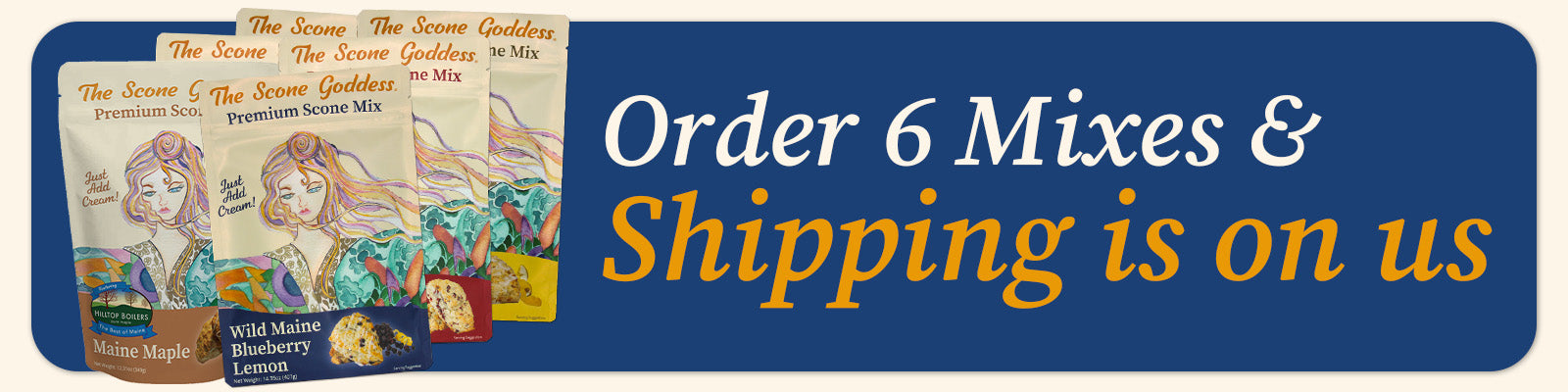
Order six or more and shipping is always free. Subscribe and it never costs you shipping again.
Sources & References
- About the Maine Wild Blueberry (Vaccinium angustifolium). University of Maine Cooperative Extension. extension.umaine.edu/blueberries/about/
- The Resilient Journey of Wild Blueberries of America: From Origins to Cultivation Challenges. USDA Blog, August 2023. usda.gov
- Blueberries. Agricultural Marketing Resource Center (AgMRC), USDA. agmrc.org
- Diverse and (Sometimes) Divergent Needs in Maine's Wild Blueberry Industry. Choices Magazine, AAEA. choicesmagazine.org
- Wild Blueberry Fact Sheet: Wild Blueberry Culture in Maine. University of Maine / Wild Blueberry Association of North America. wildblueberries.com
- Wild Blueberries and Antioxidants. Wild Blueberry Association of North America. wildblueberries.com/health-benefits/antioxidants
- Wu X, Beecher GR, Holden JM, Haytowitz DB, Gebhardt SE, Prior RL. Lipophilic and Hydrophilic Antioxidant Capacities of Common Foods in the United States. J Agric Food Chem. 2004;52(12):4026–4037. doi: 10.1021/jf049696w. PMID: 15186133. pubmed.ncbi.nlm.nih.gov/15186133
- State Berry — Wild Blueberry. Maine Secretary of State. maine.gov/sos
- Wild About Blueberries. Blue Hill Co-op. bluehill.coop
- Wild blueberry farms across Maine suffer as climate change upends growing seasons. Grist, 2025. grist.org
- The Story of Wild Blueberries — 10,000 Years in the Making. Wild Blueberry Association of North America. wildblueberries.com